
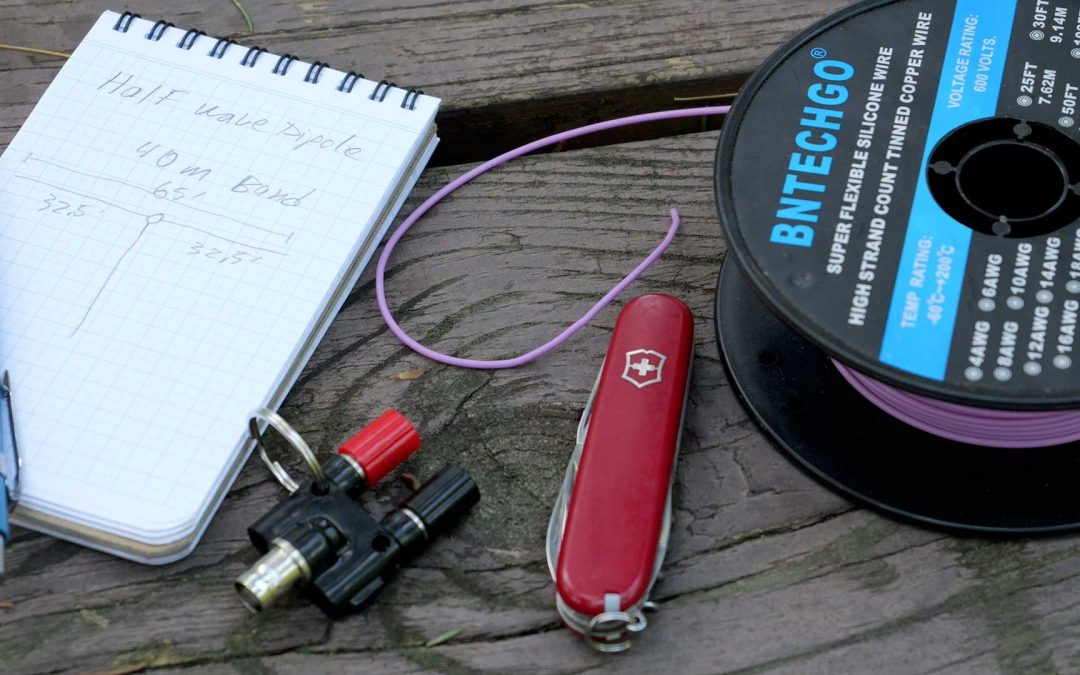
The tried and true dipole antenna can be your savior in the field. Whether you are in an emcomm situation and need to establish reliable communications, or your go to antenna broke and you need to put something together in the field. This simple dipole only requires two parts and one tool to put on the air.
That’s the topic of this week’s video: You need to build This Bushcraft Dipole antenna! Video link: https://youtu.be/Quja5S1O-IA
Parts list
BNC Female to Dual Banana Female Socket Binding Post: https://amzn.to/3SJhxAq
BNTECHGO 22 Gauge Silicone Wire Spool 250 ft: https://amzn.to/4uJmqqt
Stainless Steel Split Ring for Keychains: https://amzn.to/4oxkwYx
Victorinox Swiss Army Spartan Pocket Knife: https://amzn.to/4uGmTtF
468 vs 492
When we build a dipole antenna, we commonly use the formula 468 / Frequency MHz = Length Feet. This is what is taught on the Technician exam, and countless dipole antennas have been built using this tried and true formula.
But if you do the math, you will find that the actual formula of a dipole modeled in free space is a bit longer, requiring a formula of 492 / F MHz = Length Feet.
The 492/𝑓 formula is a conversion from metric units to English units for the fundamental frequency and wavelength (𝜆) formula. 𝑐=3×10⁸𝑚/𝑠 (the velocity of light) and 𝑓= frequency
https://ham.stackexchange.com/questions/283/calculating-antenna-length-on-the-fcc-exam-vs-in-reality
So which is correct? They both are.
Ward Silver, N0AX, did a deep dive into the history of the 468 / F formula and found that it was first mentioned in the ARRL’s 1929 edition of the ARRL Handbook.
It is stated that “The natural wavelength of the wire…will be its length in meters multiplied by 2.1” Hmmm…2.1 is 5% longer than would be the free-space value of 2. (Remember, the text is discussing wavelength, not frequency.) Farther down the page I saw, “Speaking in terms of feet, the natural wavelength of the antenna will be its length in feet divided by 1.56.” That equation translates to L = (300 x 1.56)/f and 300 x 1.56 is 468! Here were the headwaters of the mighty River 468!
Digging deeper to find the source of the Handbook formula, Silver found in the July 1925 issue of QST the justification of the 5% difference in length between the two formulas: empirical testing found that electromagnetic waves traveling along a wire resulted in them being about 5% slower than in free space. In order to compensate for this difference, the article recommended using a formula of 468/ F.
Thus our understanding of Velocity Factor is born.
So here’s where things get a little confusing. Using the formula of 468 / F is based on using a wire consisting of bare copper. The 5% correction of antenna length using bare copper vs its calculated length in free space is factured into the equation. Any insulation on the wire, or a wire composed of a different material will further slow down the electromagnetic waves and increase the velocity factor. That means if we are using insulated wire, we will need to do a further correction. In my case, I used silicone insulated wire and that results in an extra 4% reduction of the antenna length. If I did my calculations using the formula of 492 / F, I would require a 9% velocity factor correction.
I think this is a great example of the difference between theoretical calculation and empirical testing. Pure math and physics gives us a formula for the length of a half wave dipole. Back 100 years ago, amateur radio operators were still figuring things out and through testing and measurement, they discovered that using bare wire, they needed to compensate by about 5%. Thus the 468 /F formula stuck. Unfortunately the reasoning for the compensation didn’t stick with the formula
Thanks to these early experimenters, to this day hams will continue to argue on which formula should be used.
A Correction
This leaves me with a correction to the video. In building my 40 meter dipole antenna, I used the formula 468 / F MHz = length in feet. This formula will give you a correct result, and if you build your antenna out of bare copper wire, no correction for velocity factor will be required.
I used 22 AWG silicone insulated wire. If you ask google what the velocity factor of that wire is, it will say 4% (or 96% the length of bare copper). But that is assuming you are comparing it to bare copper. If you are using the formula: 492 / F MHz = Length Feet to construct your antenna, you will need to account for the velocity difference of the wire vs wave travel in free space, which is 91% the length, or 9% shorter.
Which means, if you are going to use the free space dipole formula, you will also need to use the free space velocity factor correction. If you are going to use the commonly accepted formula, you can use the commonly accepted velocity correction.
While technically I am correct in the video with my calculations and velocity factor statement. I should have highlighted my reasoning for using only a 4% correction for velocity factor, which you will find in the above article.
Bottom line: whatever formula you wish to use, stay consistent in your calculations.
Finishing Up
Field Day is only ten days away. The ARRL’s annual operating and emergency preparedness event can be great public relations opportunity for clubs. It can also be a fun and challenging contest for the single operator. However you choose to approach the event is perfectly fine.
I’ve done both, and I don’t think there is one right or wrong way to do Field Day. This year I will be once again heading deep into the Chequamegon-Nicolet National Forest to operate Field Day with the Travis, Joe, and Dave. We’ll be using club call N9CNF, so be sure to listen for us on the air. It should be a good time.
I hope to catch you on the air soon
Michael
KB9VBR

Recent Comments