
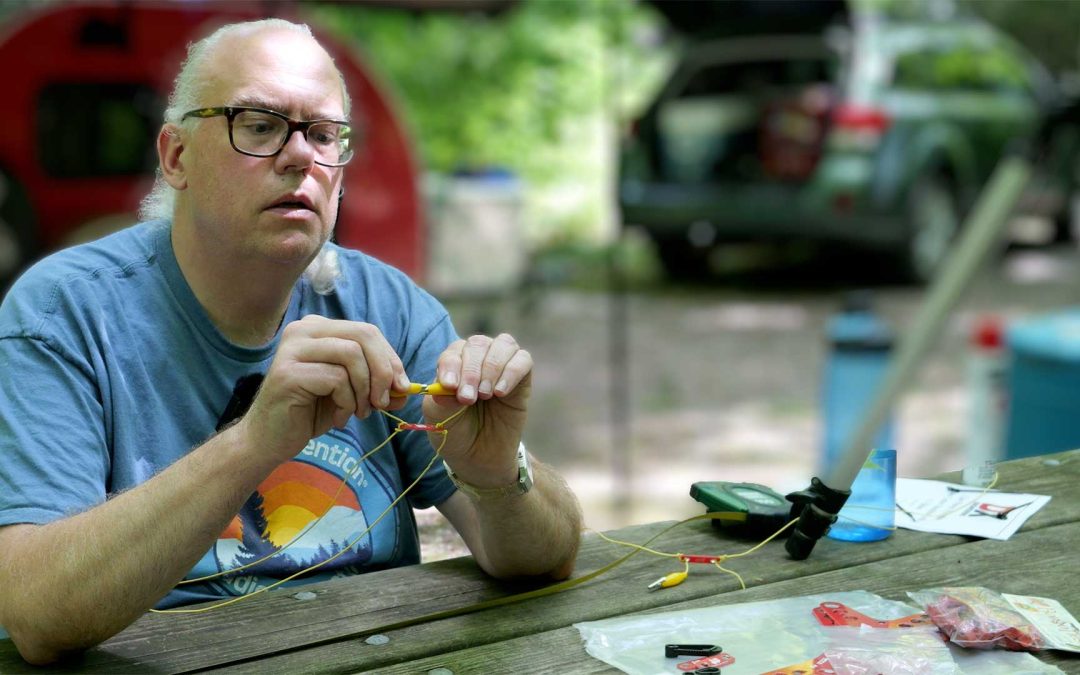
Early on, when I started doing portable operating and Parks on the Air more consistently, one of the first antennas I built was a 20 and 40 meter link dipole antenna. This antenna was heavy, made out of PVC and 14 ga THHN wire. But I used that antenna for a long time, and it always delivered a strong signal, even when band conditions weren’t the best.
Since that time, I moved away from the dipole, instead using more exotic non resonant wire antennas and fast setup verticals. But I still enjoy the simplicity of the dipole. All this summer we’ve been going back to those roots, talking about dipoles and demonstrating their construction. This week’s video: This antenna rocks, build a Link Dipole Antenna, is no exception. In it I take you through the process of assembling the DX Engineering Link Dipole Antenna kit.
Watch the video here: https://youtu.be/4umT6UGum48
For those wanting to hear a real-world test of the link dipole antenna, I have the full activation video available to watch. Content like this and more is available to members of our Patreon site. Check it out at the link below.
POTA NO EDIT: Link Dipole Antenna in the Chequamegon Nicolet National Forest
Antenna and coax provided by DX Engineering. Thank you for supporting the channel
DX Engineering Low Power Portable Dipole and Winder Kits DXE-LPB1-DWHF-RR: https://dxengineering.pxf.io/Gb1b4V
DX Engineering Low Power Balun Center Insulators DXE-LPB1-B: https://dxengineering.pxf.io/L0E0yj
DX Engineering RG-8X High Visibility Orange 50-ohm Coaxial Cable Assemblies DXE-8XVDX050: https://dxengineering.pxf.io/3kzkqK
Iso-Tip Pro 90 Soldering Iron: https://amzn.to/4xF03ol
Victorinox Spartan Swiss Army Knife: https://amzn.to/4ctfjMz
Field Expedient Antennas
If disaster struck, could you get yourself on the air quickly and efficiently? Do you have the capabilities to establish communications outside of an affected area? Maybe to pass health and welfare traffic or even coordinate communications inside the disaster area?
I’m in no way a doomsday prepper, instead I prefer to focus on resiliency. If I where to lose an antenna system, maybe due to a storm, how will I get back on the air? If I was out exploring where there is no cell coverage, how can I make a contact. Those are the everyday challenges that I would rather drill on instead of some mythical zombie apocalypse.
And that’s been my focus with the Summer of Dipole Antennas. Dipoles are the fundamental building block of just about every other antenna. Once you understand them, you gain a greater knowledge of the rest of the antenna world. Dipoles are easy to make, all you need is a length of wire and knowledge of the formula 468/f MHz = length. Commit that to memory and you are ready for just about anything that life throws at you.
I’m not done talking about dipoles, and have a couple more topics I’ll hit before the end of summer. Stay tuned for NVIS and why this method of communication is often misunderstood.
Finishing Up
Huntsville Hamfest is less than 10 days away. I am busily putting together my presentation on portable antennas for the ARRL National Convention, Friday August 21 and look forward to touring the show on the 22nd. We are taking a couple of days to get down there, Illinois is a very long state and we have to travel it’s entire length. I’m looking forward to seeing the sites. On the way down, listen for me from Starved Rock State Park in Illinois and Kentucky Dam State Resort Park in Kentucky. Those are two new parks for me to put on the air.
I hope to catch you on the air soon.
Michael
KB9VBR

Recent Comments