
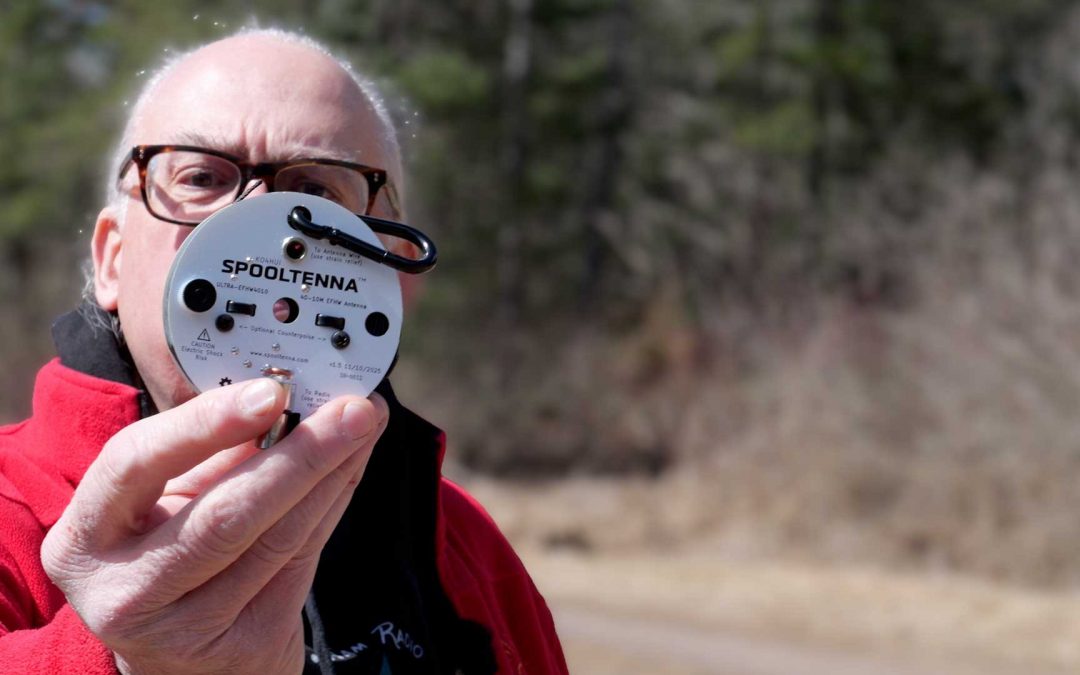
In my short list of antennas that everyone should carry in their portable antenna kit, the end fed half wave makes it into the top three. It has a couple of distinct advantages for portable use. As a wire antenna, the feed point is on one end, and it can be deployed as a sloper using only one support. Plus, keeping your feed point near your station, you can minimize the length of coax needed to feed it. These advantages in themselves often outweigh any losses you are going to receive from the 49:1 transformer.
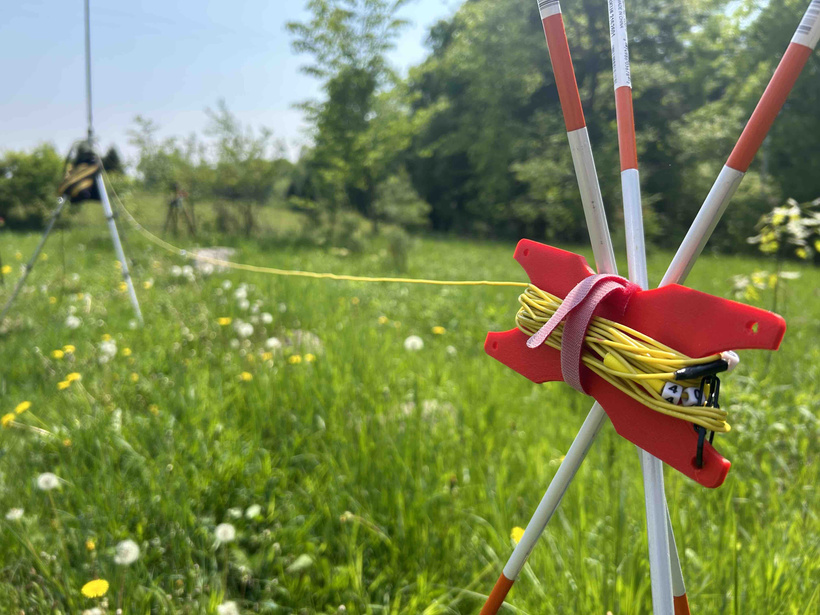
This week’s video digs into the Spooltenna Ultra, a super compact 40 meter end fed half wave antenna. Titled: Spooltenna Ultra Tested – Compact Antenna, Real Results You can watch the video here: https://youtu.be/DdSXw3iKKz8
Order the Spooltenna with the link below and receive FREE SHIPPING with your order. Use coupon code KB9VBR for free shipping: https://www.spooltenna.com?sca_ref=8592857.oEN2kdXKY73sH.
(affiliate link)
Chameleon CFM-34 Carbon Fiber Mast: https://chameleonantenna.com/products/cha-cfm?bg_ref=ok7Ky4088r
RigExpert Stick 230 Antenna Analyzer: https://dxengineering.pxf.io/rEQxKD
Choosing Portable Antennas
I often get the question: if you can only choose one antenna to take into the field, what would it be? This is such a difficult question as there is no perfect portable antenna. Antenna choices are driven more by location, band selection, and propagation conditions, more so than efficiency and top performance. That’s why I can’t be limited to just one antenna.
Let’s look at a few popular portable antennas and analyze their relative benefits.
End Fed Half Wave
Often characterized as the ham’s first HF antenna, the 40 meter End Fed Half Wave gives good four band coverage without a tuner and can be set up with as little as 60 feet of space. If I plan to band hop, and I have a support or mast with me, I’ll pick the EFHW for the convenience. But the antenna takes a bit of time to set up and recover and requires a fair amount of real estate, so it isn’t the best choice for portable operations.
Non Resonant Vertical
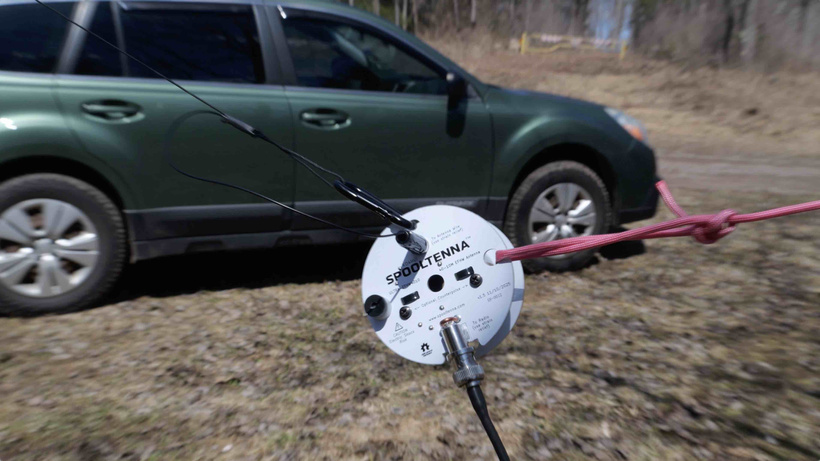
This antenna has been popularized by the name Rybakov. It’s a ground mounted vertical with a 25 foot whip, ground radials, and a 4:1 transformer at the feedpoint. The good this is that with a tuner, you can get on just about any band between 80 and 10 meters and the antenna tends to favor DX operation on the upper bands with its relatively low takeoff angle. The bad is that performance drops off precipitously on 40 meters and below. If I know I want to operate on 10, 12, 15, and 17 meters, I will often choose this antenna for its performance, as the relative gain outweighs any transformer losses.
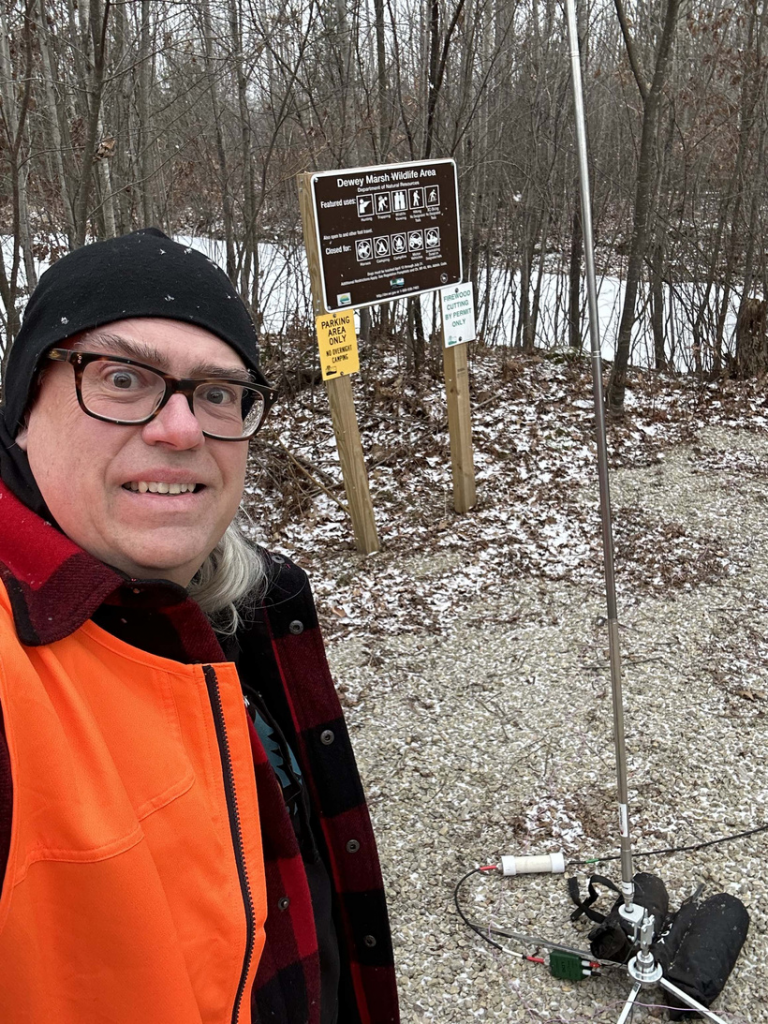
Pro tip: Adding 28 feet of wire to the top of the whip and running it horizontally turns it into an inverted L and improves its low band coverage.
Resonant Vertical
I actually lump two antennas into this category: the ground mounted vertical and the elevated vertical. Both antennas will use a 17 foot whip for operation on 10-20 meters as a resonant 1/4 wave. The whip itself is adjusted to the 1/4 wave length for each band. For 40 meters, we fully extend the whip and add a coil like the Wolf River Sporty Forty or Chameleon MCOIL.
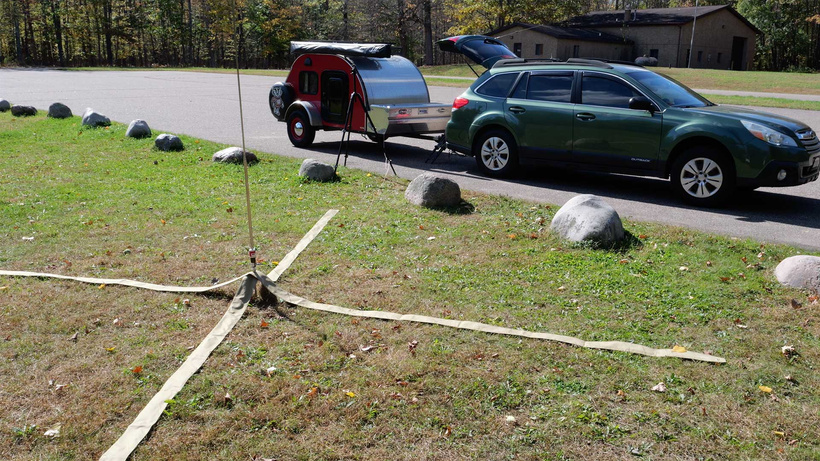
The difference between the two is the ground network or counterpoise. The ground mounted antenna will use ground level radials or faraday cloth, which I prefer, as the counterpoise. There are additional losses due to ground conductivity, but setup is very quick and the space the antenna consumes is small. The elevated antenna eliminates the ground losses as the counterpoise is in free space. But the performance gain is in the loss of convenience as the counterpoise needs to be tuned to a 1/4 wave for each band and additional space is required for the elevated wires.
Non Resonant Wire
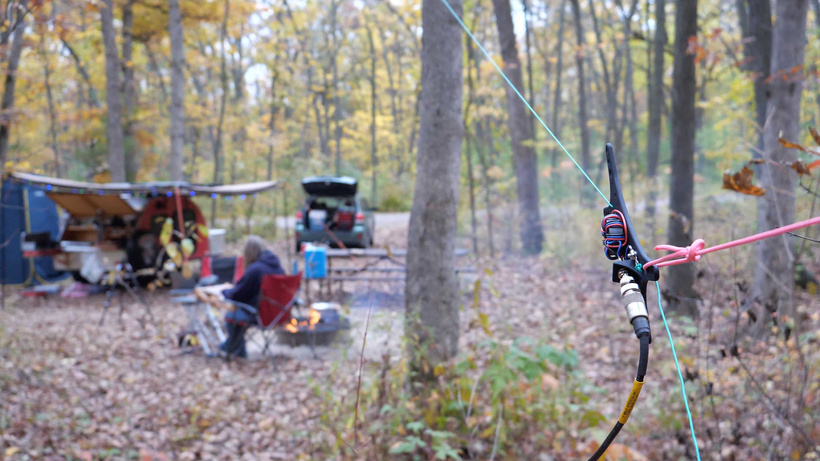
I really like non resonant wire antennas, but this isn’t always my first choice. If I am planning to use this style, two things need to happen. First, I’m going to be parked for an extended period of time, like camping for the weekend, so setting up a wire antenna and pulling out the tuner make sense. Second, I want to operate on the lower bands like 30, 40, and 80 meters. If I am going to be on 40 and above, an EFHW may be sufficient as I don’t need the tuner. There are also ways to make an EFHW work on 80 meters, but they are very narrow banded and inefficient. Still, it is good to have a ‘random wire’ with a 9:1 transformer in your arsenal of choices.
Propagation
Of these antenna comparisons, the one thing I didn’t mention was band conditions. Propagation plays a somewhat big part in my choice of antenna to use. I don’t use the propagation forecast as a go/no go indicator of operating, but instead a guide on band choice and antenna selection.
For example, if the propagation looks favorable for 10 and 15 meters, I am going to grab an antenna that favors those bands like the Rybakov. If the conditions are tough, with noise and fades, an antenna with excellent receive qualities like the elevated 1/4 vertical are going to be the best choice. Matching the antenna and its characteristics to the conditions is as important of a choice as setup time.
Finishing Up
I will start selling the six meter J-Pole antenna again next week. I took the antenna off the market about 18 months ago due to the rapidly increasing shipping rates. But there is a popular demand for it so I will bring it back for a limited time. Full details on availability and shipping can be found on my website: https://www.jpole-antenna.com/shop/6-meter-j-pole-amateur-radio-antenna/
I hope to get you in the log soon
Michael
KB9VBR

Recent Comments