

If you are in the market for a new home, you are going to run into some type of restrictive covenant that could limit your ham radio operation. It’s a fact of life, especially if the house is in a suburban development or planned community. We can yell and scream all we want about how this shouldn’t be the case, but that won’t solve the problem. Instead, if you are committed to living in a new home, or anything built in the last 30 years for that matter, you are better served to work around the system.
That’s the topic of this week’s video: Ham Radio in an HOA? Here’s What Works!
Watch it here: https://youtu.be/fn51X7EEXjk
CHA HOA GUIDE First Edition: https://chameleonantenna.com/products/cha-hoa-guide-first-edition?_pos=1&_psq=hoa&_ss=e&_v=1.0&bg_ref=ok7Ky4088r
This book isn’t just for HOA dwellers. I live in a house that’s over 100 years old. It’s in a neighborhood that’s even older. My lot is an average 60×120 feet and it’s taken up with the detached garage and three large trees. Theoretically, I could put up whatever antenna I wished to (within reason of the zoning code). But it is a struggle to install highly efficient antenna systems, especially if I want to operate on more than one band. So don’t let the title fool you, the tips and ideas in this book go beyond HOA restrictions and work well in overcoming physical space limitations of your antenna system.
The Magic Carpet
I think it might be time to do another video on Faraday cloth.
Faraday Cloth is a fabric that is impregnated with metal strands or fibers. The purpose of the cloth is to make electromagnetic pulse (EMP) proof bags and containers. I’m skeptical about the efficacy of using the cloth for that purpose, but it does make a great RF ground network for vertical antennas. I have a video that demonstrates how I use faraday cloth as a ground network.
In the last week I’ve noticed a couple of social media posts online of people using faraday cloth in good and poor ways. First the good:
The operator was using a large 4×8 foot sheet of faraday cloth as their ground network. They found this size to be cumbersome as the corners were blowing around. Folding the cloth in half, so it had a smaller footprint was easier to work with as it took up less space.
Why this works: When we use faraday cloth sheets, we need to consider the surface area the cloth covers, and not the physical dimension of the cloth itself. When we talk about ground mounted radials, we often discuss them in length like 16 feet or 33 feet and the number of radials laid down: 4, 8, 16, etc. The more radials we lay down, the more area we cover, and the greater capacitive coupling we receive from the ground.
With faraday cloth, it’s all about surface area. The more surface area we cover, the greater capacitive coupling. For the upper bands, 16-20 square feet is more than adequate. As you go forty meters and lower, you will find that adding more surface area, like an extra sheet or fully deploying the sheet you have, will result in a better impedance match. Knowing how surface area affects coupling will go a long way towards better utilizing your cloth.
Now the bad:
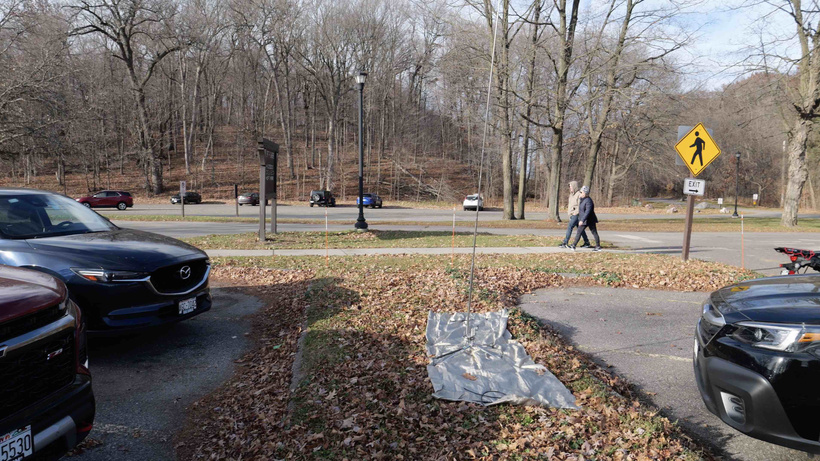
The operator is using the faraday cloth with their surveyors tripod. The cloth is on the ground and the tripod is set on top with the feed point a good four feet above the cloth. There is no indication that there is any continuity or electrical connection between the cloth and the antenna’s ground side. This setup will not work.
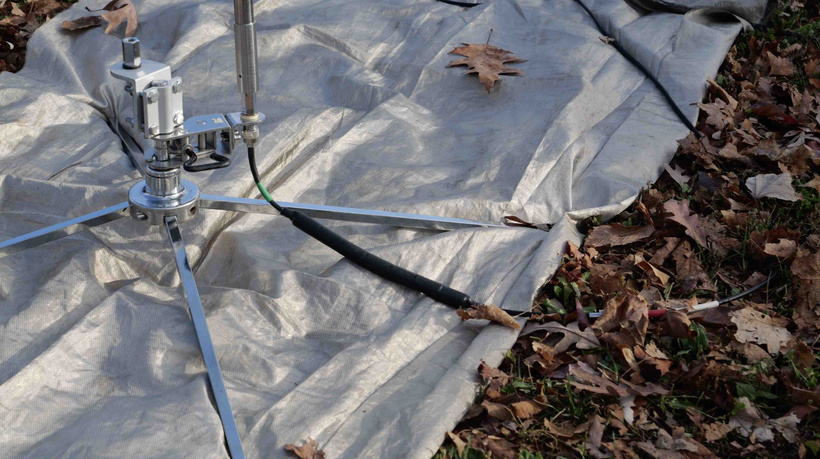
The key concept we need to remember is that the faraday cloth part part of your antenna system and it needs to be connected to the ground side, or return path, of your coax. That means you need to provide continuity or an electrical connection from the cloth to the antenna ground. I like to use an antenna base that it electrically connected, but a couple of short jumpers will also do the trick. If you are unsure of your setup, do a quick continuity check with a multi meter between the cloth and the shield of your SO-239 to assure you have that connection.
The second reason this fails is that this form of vertical antenna is a ground level antenna. The feedpoint needs to be close, if not at, ground level. Raising the feed point up 2, 3, 4 feet or more will negate the affects of your ground network. (Elevating the feed point works great but requires a different style of counterpoise). Get the feedpoint low, less than 12 inches, and it will work great.
I hope these tips help, especially if you are having troubles either getting a good match or not making any contacts with your ground mounted vertical antenna and faraday cloth.
Finishing up
Producing video content, and getting on the air for that matter, has been a struggle the last couple of weeks. Between the 30 inch snowfall we received 10 days ago, and running for reelection on the Wausau City Council, my on air time has been greatly curtailed. Election day is Tuesday April 7, so I do see the light at the end of the tunnel. But it is going to be crunch time for the next two weeks. Thanks for bearing with me.
I hope to get you in the log soon
Michael
KB9VBR

Recent Comments