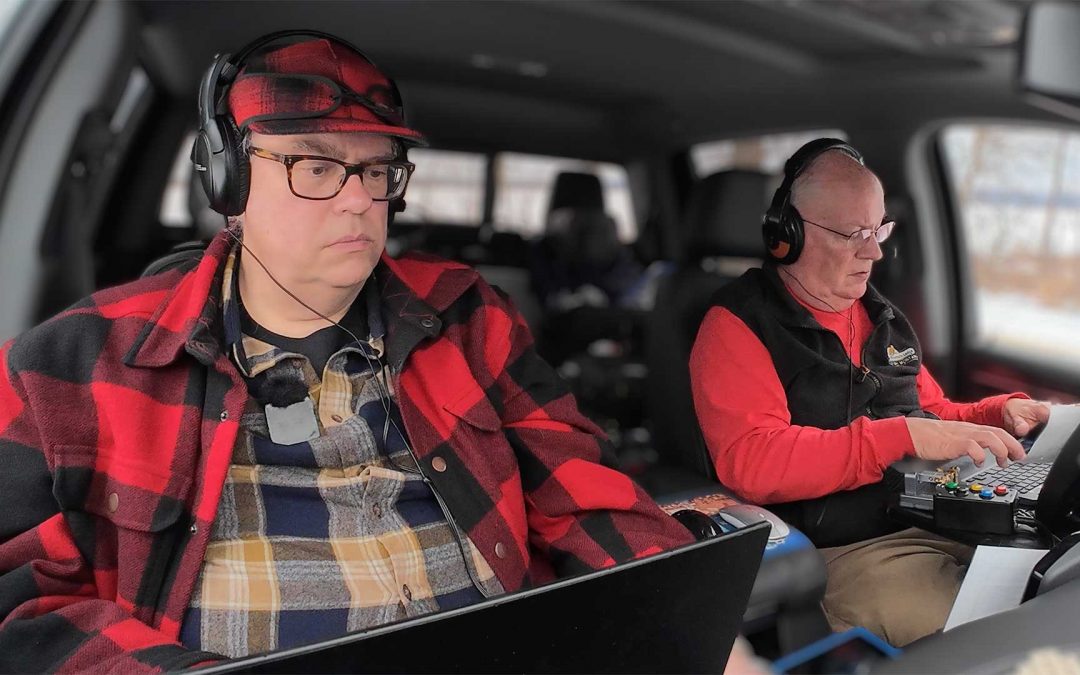
QSO Parties are a lot of fun. They are a low barrier entry into the world of contesting. You can operate casually or go full bore. And the best part is, your efforts are recognized no matter how little or long you operate. With our close proximity to the state of Minnesota, Dave and I have been crossing the border to operate as an instate station for the Minnesota QSO Party.
That’s the subject of this week’s video: We Crushed it! Minnesota QSO Party 2026: https://youtu.be/liJA7tfd0xE
Minnesota QSO Party preliminary scores:https://www.3830scores.com/currecscores.php?arg=Rv7uuizV77JYJU
Minnesota QSO Party: https://www.w0aa.org/mn-qso-party/
Koss SB40 Headset: https://amzn.to/45XASBS
RJ-45 Ethernet Extension Cable, g feet: https://amzn.to/3OioupX
RJ-12 Extension Cable 6 feet: https://amzn.to/462KaN4
Rez Antenna Scout Antenna System: https://dxengineering.pxf.io/LKQy0j
KF8ASE Ham Radio Chokes: https://www.etsy.com/listing/1903048443/messi-paoloni-ham-radio-rfi-chokes-for
Morgan Systens Band Pass Filters: https://www.surgestop.com/filter-products/
SADDLEBAG Design Weight Bags for Photo Video: https://amzn.to/46E3SPE
N1MM Logger+ Ham Radio Contest Logging: https://n1mmwp.hamdocs.com/
Three things we learned from the Minnesota QSO Party
This is our third iteration at the Minnesota QSO Party. The first three times we entered the Mobile/Rover category and the last two years as a fixed multi-operator. Our transition from mobile to fixed was simple: the mobile categories don’t allow for multi transmitter operation, so if both of us wanted to be on the air at the same time, we would have to stay in one location. Staying fixed increased our efficiency as we didn’t have to break down and move to another county, but it also makes us compete against other, better appointed stations, with permanent antenna systems. Still, what we can do as ‘two guys working out of a truck’ hasn’t happened by chance and our years of hard work and improvement can be distilled into these things.
Go in with a plan, and know when to deviate
The hardest lesson we’ve had to learn over the years is the power of the plan. Key stumbles that have cost of points and times can be directly attributed to not following our plans, or having a plan that was unrealistic.
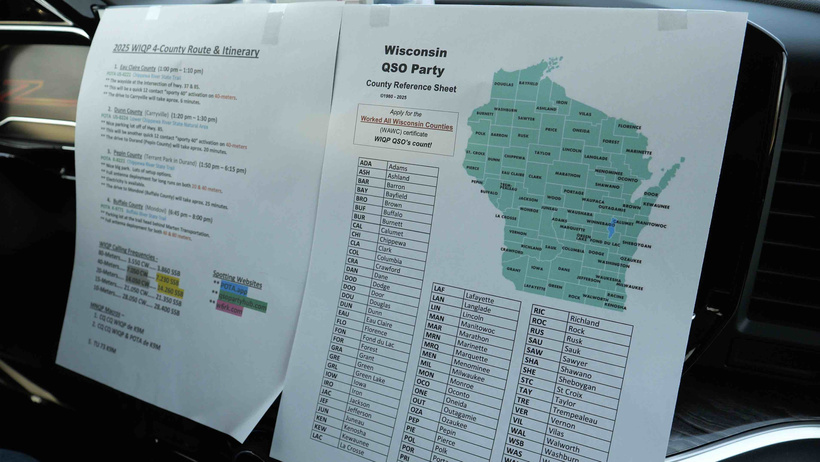
When we operated mobile, we’d time things down to the minute: when to set up, when to tear down and how long to operate. We learned quickly that set up, tear down, and travel from location to location takes longer than expected and doing something like a quick restroom break can throw the schedule in a tailspin. We also learned that once you are on the air and established, if you’ve got a good run going, you can’t just stop it because the clock says you need to move.
Conversely, spending too long on a band or mode that isn’t delivering results is counterproductive. If the contacts aren’t there, you need to make adjustment.
For this year’s event, our plan was simple: Dave would work 40 meters to rack up as many multipliers he can. He would search the spotting page and be flexible to grab a new county when one popped up on the list. On the other hand, I would stay on 20 meters phone and just hammer contacts, racking up points for the event. In theory this worked great, and allowed us to get 100 multipliers by 1:00pm, halfway through the event. But by the time the 40 meter had dried up and Dave saw quite a bit of 15 meter activity on the spotting page. Since we felt that our multiplier number was in good shape, it was reasonable to switch bands. And that was a good call, adding another 175 contacts and three new mults to the log.
Things like band conditions, equipment failures, or poor timing can throw off your plans really quick. Having flexibility can save you from disaster. But that flexibility has to rooted in a plan to begin with.
Logging can’t be an afterthought
When we first started doing QSO parties competitively, we didn’t think much about logging. Maybe as a single operator, we’d pass the computer back and forth, or one person would log and another would operate. Heaven forbid, the first year we went mobile, we did it all on paper. Cleaning up that log was a big fat mess.
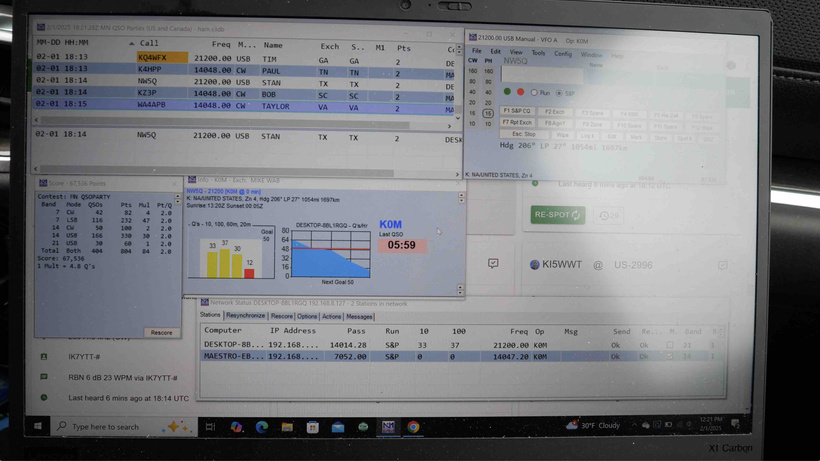
For the past three years we’ve settled on N1MM Logger+. This is a contest logging system built like no other. I will admit that it has a bit of a learning curve and Dave and I are still learning a new feature found in it every time we use it.
What Dave likes about N1MM is the built in macros and automation for CW operation. This streamlines the CW QSO process and allows him to run at a higher rate than he normally would. You know those other contesters running 30-35 words a minute? Yep, they’re using automation to keep their rate up without tiring out.
What I like about N1MM is its simple network support. Running multiuser is as simple as turning that feature on. No shares or Windows networking expertise is necessary. The computers find each other and just work. If a connection fails, everything still works, and seamlessly syncs back up when the connection reestablishes itself. This is mission critical stuff that N1MM is doing in the background, and I find it totally amazing.
To make the networking easier, I bought a little travel router that can run off a USB battery pack. Everyone connects to the router and we can add a Jet Pack or hotspot to the mix for everyone to have Internet. It’s all easy peasy.
Leverage the power of POTA
This is our secret ingredient to success. We’ve found early on that Parks on the Air delivers a ready made field of hunters and can help us sustain long runs of contacts during the event. Most QSO parties allow for self spotting and setting up in a park and putting our callsign into the spotting page delivers a pileup. Sometimes you need to educate a bit on what the exchange needs to be, but the beautiful part of POTA is that it is flexible and its minimal requirements for what makes a valid contact blends into every contest.
When we operate mobile for the QSO party, we pick park entities that are close together and build a route that goes from county to county and park to park. At each park we stop for an hour and operate and then move to a new park in a new county. The cool thing is that switching parks and counties recycles our list of hunters longer and more sustained runs.
When we operate stationary, like we did in Minnesota this year, we don’t have the benefit of recycling hunters, but there is such a large number of POTA enthusiasts out there, that even if you get a few duplicate contacts, there are enough people to looking for you, to make using POTA worth your while.
Finishing Up
Our next big QSO Party is the Wisconsin QSO Party on March 15. Dave and I will be on the road again. We are in the process of mapping a route and putting together the plan. While we are stationary the entire time in Minnesota, Wisconsin allows a multi transmitter mobile category, and we will move around a bit. More information will be coming as we get closer to the date.
I’m road tripping this weekend, visiting my daughter and going to the Wisconsin Garden Expo in Madison. Saturday’s drive home will include a few parks, all of which should be new to me. Depending on time, I hope to hit at least three. Watch the POTA spotting page for time and frequency.
I hope to get you in the log soon.
Michael
KB9VBR

Recent Comments