Over the years, I’ve demo’ed countless end fed half wave antennas. Operation on most of them is pretty much all the same. I’ve said numerous times that an end fed, is an end fed, is an end fed. Despite minor differences, you are going to get similar results.
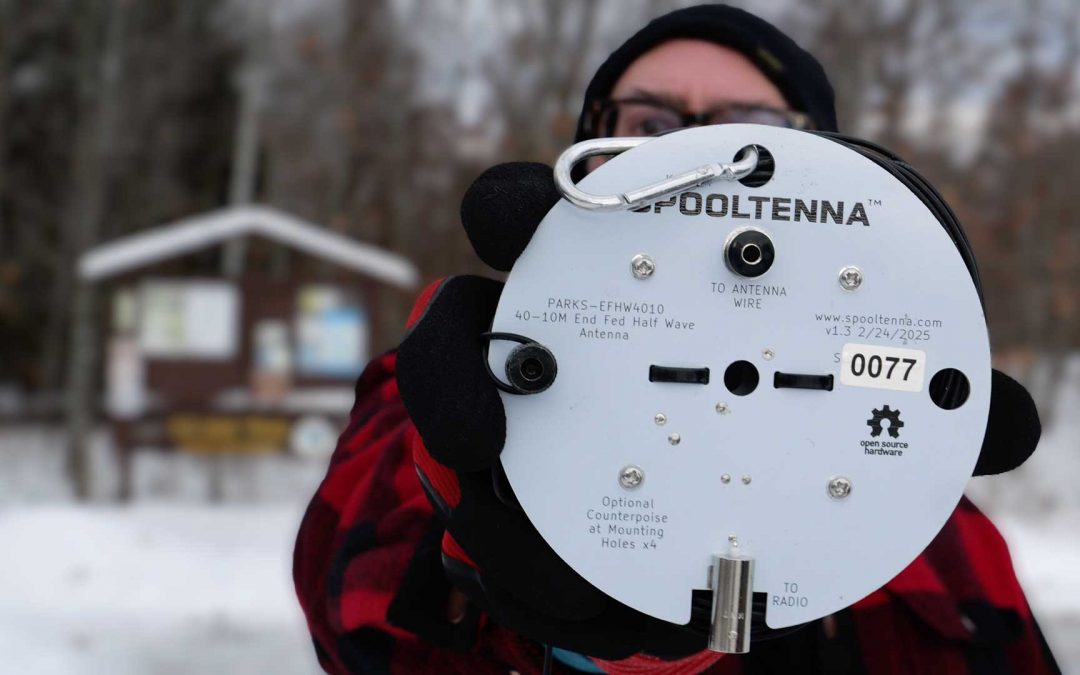
But there is one one end fed half wave antenna that I’ve found to not only be one of the easiest to set up and tear down, but also consistently the best in operation and on air performance. That’s the Spooltenna end fed halfwave.
That’s the subject of this week’s video: AMAZING Spooltenna heats up FOUR ham radio bands! Watch now: https://youtu.be/QzIiwt_cigY
Order the Spooltenna with the link below and receive FREE SHIPPING with your order. Use coupon code KB9VBR for free shipping: https://www.spooltenna.com?sca_ref=8592857.oEN2kdXKY73sH.
(affiliate link)
Jackite 31 Foot Fiberglass Pole: https://amzn.to/4khVD0X
Field Notes Spiral Bound Memo Book: https://amzn.to/4by0KIf
Pentel Sharp Mechanical Pencil, (0.7mm): https://amzn.to/3ZhChiZ
Chasing DX is not the goal!
This sounds like a bit of a hot take, but stay with me here.
Since the earliest days of ham radio, experimenters in the hobby would strive to see how far there signal to go. At that time radio operators were relegated to 200 Meters and Down, and would operate with primitive spark gap equipment. To get your signal to go 20 or even 30 miles was an achievement. The ARRL, originally called the Amateur Radio Relay League was founded on the premise to link stations together so messages could be passed, or relayed from one station to another.
Technology advanced, our understanding grew, and great distances in radio communication were achieved. Pushing the distance limit on all bands and modes is noble, and predictably that mindset stays with us today. For example, if I demonstrate an antenna system, it typically will get dismissed as not being ‘good for DX.’
I’m here to say that chasing DX, or international long distance contacts, may not be the goal.
Case in point: this weekend, February 7 2026, is the Minnesota QSO Party. Dave, KZ9V, and I operate in this event (callsign KØM) by setting up as a portable station in a park in Minnesota. Beside making contacts, we want to collect as many Minnesota counties, US States, and Canadian provinces as possible. All other DX contacts, while counting as contacts, do not provide an extra multiplier for us. There is no incentive for us to focus on them. So naturally I will want an antenna that favors stateside operation. I don’t want my signal to ‘skip’ over the continental US. In this case, a high angle of RF radiation is a good thing.
Over the years doing these events, Dave and I have auditioned many different antennas and have come up with two models for our QSO party contest station: the End Fed Halfwave and the 1/4 wave elevated vertical.
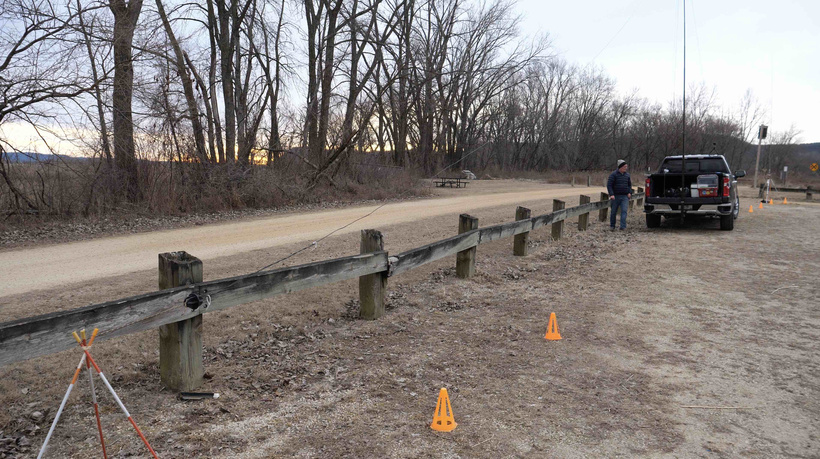
Let’s start with the EFHW, this antenna gives us resonant performance on 40, 20, 15, and 10 meters, with 40 meters being the fundamental frequency. Dave’s job in our multi operator effort is to collect in-state counties on primarily the 40 meter band. Our EFHW is relatively low, with a peak at about 25 feet, giving us a somewhat NVIS or Near Vertical Incidence Skywave propagation. Perfect for grabbing those Minnesota counties. The antenna will also provide regional communications into nearby states, filling in the holes that I am going to miss with my antenna. He will switch between CW and Phone and watch the spotting pages to grab counties as they come up.
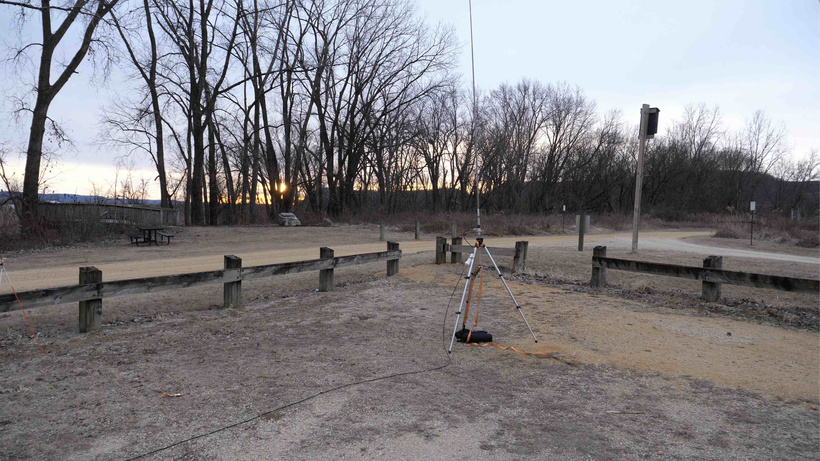
Since Dave is the multiplier man, I am the points person. Focusing exclusively on the 20 meter phone band my job is to make contacts, lots and lots of contacts. For that I am going to use an antenna with a good signal and solid stateside performance: the 1/4 wave vertical, notably the configuration championed by KJ6ER. It’s the PERformer antenna! I want to hit every state and province, but also count up all the points or contacts that I can muster. The PERformer, with it’s elevated counterpoise wires exhibits an 18 degree RF takeoff angle and a secondary lobe at about 3- degrees. That’s considered high for Dx, but perfect for the states.
The combination of those antennas is a powerhouse! For both the Minnesota and Wisconsin QSO parties it has brought us to the brink of 1000 combined contacts. Could we shatter that record this year? Time will tell. Understanding your needs, knowing your tools, and picking the right one for the job is the hallmark of a professional.
Finishing up
You can help us break through the 1000 contact barrier. Listen for the station KØM on the Minnesota QSO party on Saturday February 7 from 8:00am – 6:00pm CST (1400Z – 2400Z). We are in Wabasha County, MN at POTA US-4236, Upper Mississippi Wildlife Refuge. Spotting is allowed and both Dave and I will be spotted in the park and on other spotting pages. The exchange is simple, all I need from you is two things: State/Province and your first name. I’ll give my name to you, so be ready with yours.
I hope to get you in the log
Michael
KB9VBR

Recent Comments