
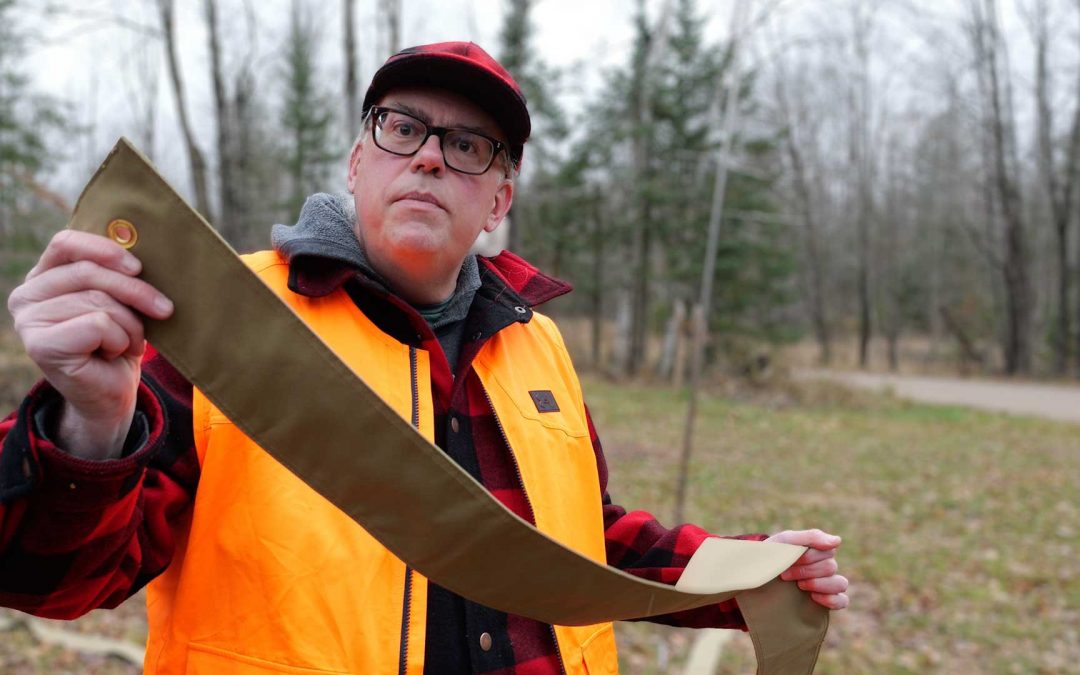
My first real exposure to the Rybakov antenna was back about two years ago. I was playing with the Chameleon URT-1 remote tuner and needed a portable vertical to demonstrate the tuner’s usefulness. I ended up combining the Chameleon 17 foot whip with the Chameleon MIL-EXT extension to create a 25 foot monster I dubbed the ‘Frankentenna.’ Fortunately with the introduction of the 25 foot telescoping whip, deploying this non resonant vertical antenna has gotten much easier and to this day it continues to be one of my favorite antenna’s to deploy.
When Chameleon introduced their Faraday Strip Radial system, I knew they were going to be a game changer. I was having great luck using it as a resonant ground network, so I wanted to test it out with a non resonant antenna. Let’s just say I was instantly won over and the results are the subject of this week’s video: The Rybakov Antenna Made BETTER with Faraday Strip Radials Watch here: https://youtu.be/Nf4GzUkXVCs
Products Mentioned:
Chameleon SS25 25 foot whip: https://chameleonantenna.com/keyro0
Chameleon Insulator: https://chameleonantenna.com/axXN3W
Chameleon Faraday Strip Radials: https://chameleonantenna.com/cg0QIe
LDG 4:1 Transformer: https://dxengineering.pxf.io/gO2eor
LDG Z11ProII Auto Tuner: https://dxengineering.pxf.io/VxzQBO
Learn more about the Faraday Strip Radials: https://youtu.be/oMnQppoFhoE
Original IV3SBE Rybakov Design: https://web.archive.org/web/20061021180939/http://www.iv3sbe.webfundis.net/html/Rybakov806-ita.htm
Winter Field Day
Winter Field Day is fast approaching and the annual event has got me thinking about antennas. More precisely, which antenna do I want to deploy. While summer field day antenna deployments are relatively easy: the weather is warm and the ground soft enough to drive stakes into it. The cold, snow, and frozen ground adds a whole new level of complexity.
In previous years I’ve deployed end fed half wave antennas, either a 40 meter version, or like for the last two years, a monstrous 80 meter wire. I’ve had good results with that setup, although I feel like I didn’t get the low band contacts I had hoped for. Part of the reason may be because I didn’t stay up late enough, but more likely, band conditions just weren’t that favorable for 80 meters.
Which leaves me at a dilemma, my bread and butter is 20 meter phone. I need the most efficient radiator for that band. But I want to be able to shift to 40 meters as we head into the evening or in the early morning hours. As much as I love the versatility of the 80m EFHW, I feel that it may be holding me back. Which brings me to my plan for this year.
To help decide on what to deploy, I’ve put together the following criteria for my winter field day antennas.
- DX is not a priority. WFD is primarily US and Canadian stations. The antenna I pick needs to cover the states and provinces, and that’s it. But it needs to do it well.
- The antenna needs to be efficient. WFD, especially on 20 and 40 meters is a game of who can put out the best signal. I’ll be running 100 watts with a battery, so I need to minimize my losses.
- The antenna needs to be easy to deploy. Structures are limited and the ground is frozen. And for all I know, the weather may be in the single digits and snowy. I don’t want to spend hours outside futzing in the cold with a balky antenna.
That leaves me to the following choices:
- 20 meter dipole. My bread and butter band will be covered with a bread and butter antenna. If I can get the peak up about 30 feet, all the better.
- 40 meter Off Center Fed Dipole. I’m leaning towards this as it lets me easily drop to 40 meters for the evening hours. My Chameleon OCF is super lightweight and I’m reasonably sure I can deploy it with a 30 foot fiberglass mast lashed to the deck of the cottage.
- Elevated 1/4 wave vertical (aka KJ6ER PERformer). The Elevated 1/4 wave has been a solid performer for my participation in the MN and WI QSO parties, and I think it would do well for WFD. My actual thought is to rig this antenna for 40 meters, or even 80 meters with a Wolf River SB1000 coil and switch to it from the dipole for the low band operation.
This year we will again be operating from a cottage on Big Roche Lake in Adams County, Wisconsin. We’ll have modern conveniences and a far bit of space to set up antennas. Take a look at the map and tell me what you think. For reference, it’s 70 feet from the cottage to the lake, the lake is frozen, and the land slopes downward to the water. I’d love to hear your ideas for Field Day antenna setups.
Here’s last year’s Winter Field Day video: https://youtu.be/beohSuGKs-w
Finishing Up
Don’t forget your common mode chokes! Dave and I have found that one of the most effective methods of reducing interference from adjacent stations is, in addition to a band pass filter, putting a common mode choke at the RF output of your transceiver. I’m using the Rez CM-7 Common Mode Choke for my portable operations. The braid of your coax acts like a receiving antenna, and choking it will greatly reduce that energy from returning to your receiver.
The January thaw has come and gone and the cold weather of winter has returned. Temps this weekend will be in the single digits, we’ll see if that gets me out into a park or not on Saturday. I may just stay home and hunt activators.
Whatever the plan, be sure to stay warm and dry.
I hope to catch you in the log soon
Michael
KB9VBR

Recent Comments